


Internationalization
Home > Internationalization > Abdulaziz saud albabtain cultural foundation
“Arab Language and Culture Day” and Promotion of the Book Culture in Kuwait at MUA

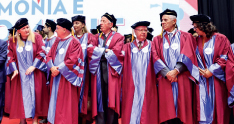
The Mediterranean University of Albania and the “Abdulaziz Saud Al-Babtain” Chair for Arabic Language and Culture organized, for the fourth consecutive year, the cultural event “Arab Language and Culture Day” on the occasion of the World Day for Cultural Diversity for Dialogue and Development, proclaimed by UNESCO. The Albanian translation of the book Culture in Kuwait by Dr. Khalifa Al-Wuqayyan was promoted as well during this ceremony.

The event took place on May 21, 2026, at the premises of the Mediterranean University of Albania in Tirana, with the participation of ambassadors from Arab countries accredited in Tirana, representatives of the diplomatic corps, academic and cultural institutions, as well as university professors and students.

Prof. Assoc. Dr. Arben Cici, Pro-rector of the university and Director of the “Abdulaziz Saud Al-Babtain” Chair for Arabic Language and Culture, opened the ceremony by emphasizing the importance of the Arabic language as a bridge of cultural communication and rapprochement between civilizations. He also highlighted the role that MUA plays in strengthening cultural and academic relations between Albania and the Arab world. “Dr. Khalifa Al-Wuqayyan brings to the Albanian public the profound dimension of the spirit and culture of the friendly Kuwaiti people,” Professor Cici underlined.

Academician Anastas Angjeli, President and Founder of the Mediterranean University of Albania and Chairman of the Board of the “Abdulaziz Saud Al-Babtain” Chair for Arabic Language and Culture, welcomed the attendees and stated that the Albanian translation of Culture in Kuwait by Dr. Khalifa Al-Wuqayyan constitutes an important step toward greater mutual understanding between the Albanian and Kuwaiti peoples, while also contributing to the expansion of cultural and academic cooperation between the two countries.

His Excellency the Ambassador of the State of Kuwait to Albania, Mr. Mohsen Al-Ajmi, emphasized the importance of cultural diversity and dialogue among peoples, noting that relations between Kuwait and Albania are experiencing continuous development in the cultural, educational, and diplomatic fields. He described Culture in Kuwait as an important work documenting the development of the Kuwaiti cultural movement and highlighting its contributions to the intellectual, literary, and artistic spheres.

In her speech, Ms. Vilma Premti, Deputy Minister for Europe and Foreign Affairs, stated that culture and language remain important instruments of cultural diplomacy and rapprochement between nations. She reaffirmed Albania’s commitment to supporting intercultural dialogue and strengthening cooperation with Arab countries in areas such as education, culture, tourism, and people-to-people exchanges.

The Director of the National Library of Albania, Ms. Majlinda Toçi, underlined in her speech that Arab culture represents one of the richest legacies of human civilization, having significantly influenced philosophy, science, literature, art, and intellectual thought. She emphasized that concrete evidence of this heritage is represented by the manuscripts, books, catalogues, and historical materials preserved in the collections of the National Library of Albania.

The translator of the book, Mr. Fatbardh Shega, spoke about the process of translating the work, sharing with the attendees the passion, challenges, and importance involved in bringing such a work into Albanian, thereby introducing Albanian readers more closely to the culture and history of a friendly country such as Kuwait.

At the conclusion of the event, participants emphasized the important role that culture and language play in building bridges of communication among peoples and in strengthening the values of tolerance, understanding, and mutual dialogue. The attendees were then invited to visit the Arab culture and cuisine fair organized in the university lobby, with the participation of several Arab embassies accredited in Tirana.
This activity reflected the important role that academic and cultural institutions play in strengthening civilized dialogue and cultural relations between Albania and the Arab world through knowledge, translation, academic cooperation, and cultural openness — a role that the Mediterranean University of Albania and the “Abdulaziz Saud Al-Babtain” Chair for Arabic Language and Culture have successfully fulfilled for four consecutive years.
FACULTIES
Faculty of Economic Sciences
The Faculty of Economic Sciences prepares young economists with fundamental theoretical concepts in economics, finance, accounting, business, law, as well as the essential practical skills required for economists, managers, financiers, bankers, accountants.
Faculty of Law and Human Sciences
The Faculty of Law and Human Sciences prepares individuals for careers as lawyers, political scientists, diplomats, and communication specialists. It provides them with the necessary theoretical foundation and practical knowledge to effectively navigate the challenges of the justice system and international relations within the country.
Faculty of Informatics
The Faculty of Informatics, both physically and virtually, is dedicated to the latest advancements in computer science, systems, and development technologies. In an era of rapid technological progress, the academic curriculum keeps pace with the support of highly qualified faculty members. Teachers and students collaborate on joint projects, pooling their efforts to achieve outstanding results.
Faculty of Medical Sciences
The Faculty of Medical Sciences is an ambitious endeavor of MUA aimed at enhancing the country's medical capabilities. As with every step taken towards achieving excellence, MUA has enlisted the expertise of renowned professors in the relevant fields for the new faculty. By designing programs aligned with the best practices in Europe, MUA ensures the present and future safety of its students.
- Bachelor
- Master of Science Studies




Some important numbers
-
35+
Programmes
-
150+
Professors
-
3500+
Students
-
85%
Employment